Tuesday, November 9, 2010

Green stuff

I feel like my veins are full of it. Here I am in the home stretch of the fall semester, and I realize it's just accumulated--all this negative energy, criticism (towards myself and others), disapproval (again towards myself and others), fear, anger, righteousness, hypocrisy, self-criticism after the hypocrisy, hopelessness, and let's not forget physical tension. It's like bile bubbling up in my stomach and throbbing in my temples. How is it that I can be aware of it all, and aware that it's bad and illogical, and still have no control over it? I guess the point is to relinquish control...over everything! Well that doesn't seem right.

If I decide I'll try to ease up on being controlling, somehow I associate that with not practicing as much. Probably because I do believe in being able to control how good you get by how hard you work. And hard work equals practice, both length and quality of. It also equals reading analytical articles about piano playing; about the psychology of music; about the anatomy of the arms; being so immersed that you think about it constantly. But then, I guess, if you're like me, it becomes unhealthy. But swinging back to the other extreme is no good either--I can't just not practice and expect to learn anything. I also tend to let one thing in my life affect the rest of the things...and if I stop controlling anything, I'd probably also stop contacting people and forget to feed myself altogether.

In music especially you have to be so so proactive and willing to put yourself out there and take opportunities. I feel like I'm handicapped, though, and that I can't take the opportunities I want to. I have become so bitter--I feel it's unfair that other people don't have the problems I do; why do they deserve an easy ride any more than I do? But nobody is perfect. Everyone has problems. And I take comfort in figuring out what they are, maybe to make myself feel less alone, or maybe to give myself some strange sense of superiority, like, well maybe I still have arm pain after 2 years, but at least my emotional life isn't empty and I won't die alone with my music. That's a stupid example, though. AND when I get all bitter, it bleeds into my emotional life anyway!

Sunday, October 3, 2010

Other people's trash

is my treasure! I've become addicted to the Goodwill. The church I play piano at is also having a rummage sale right now where I got a pair of shoes, 2 shirts, a briefcase and a copy of The Odyssey for a total of $5. Why do people get rid of this awesome stuff? What of my stuff that I consider old and crappy would someone else find fresh and exciting?

Sunday, September 12, 2010

My lips feel like

I was watching some Pete and Pete today (early 90s Nickelodeon TV shoe*), and marveling at this seriously swell writing. 

First of all, characters: 2 brothers both named Pete (parents obviously crazy, and Mom even has a metal plate in her head and can pick up radio stations with it), jilted emotive school bus driver, creepy history teacher with legendarily disgusting varicose vein legs, Artie--unclassifiable random man always dressed in Where's Waldo-esque garb of red/striped spandex suits and accomplishing feats of strength as he hangs out with children.

Secondly, script: In an episode where the family takes a road trip and Dad has a complex about being "King of the Road," his confidence is measured by how far he lets his elbow stick out the window; at the end, after winning a competition with another vacationing family, Big Pete reflects on family loyalty and the feeling of a job well done: "We let our elbows do the talking."
Another episode, Big Pete, who plays trombone, complains of too much marching band rehearsal: "My lips feel like warm cheese."
Another episode, Little Pete, to a disciplinary adult: "Wax my nose hairs!"
Another episode, Big Pete is ashamed to work at the golf range, driving the cart and gathering all the golf balls, decides to wear a giant bear suit to hide his identity but at the end gains courage and unmasks himself in front of his peers, who promptly say in disgust, "You're a range boy?" to which he replies proudly: "I'm not a range boy, I'm a range bear."
Maybe you find this tantalizing taste I've given you to be completely incoherent and worthless. Maybe you will rush to rent the first season from Netflix or your nearest "movie buff's paradise" (if you're as lucky as I am to have one near you and so conveniently spelled out in neon letters for you so you know what it is). The way I see it, you can either take the random information that comes your way and let it add to your life, or you can assume seeming randomness does not apply to you, forget about it, and gain nothing.


Nickelodeon sure is better at teaching morals through a well crafted tale than I am!


But seriously. My teacher, Dr. Rosenkranz once told this story about a prestigious composer's class held by Olivier Messiaen, where Messiaen held all these preliminary examinations to select his pupils. He made them write fugues, take tests, all sorts of hoop jumping. And then, when they finally show up, he shows them, of all things, his rock collection. He points out how each rock is so amazing, has its own "suchness." Rosenkranz's friend who attended said he was simply befuddled until very much time had passed after the class and he was able to take what Messiaen said about the rocks and apply it to composition. Each piece of music needs to have its own "suchness," its own certain thing about it that makes it unique.


So, suck up everything you can, like you're a dustbuster and the world is a treasure trove of cat hair, because you'll never know when it may enrich something later on (or maybe you'll figure out something later that you really should've comprehended at the time it was offered to you but you were just too dense. Either way).

*This should say show, and I saw my error as soon as it happened, but I love the way shoe looks and the hilarious possibilities of visualization it offers so I left it.

Wednesday, September 1, 2010

Fruit fruit fruit fruit

I love the pear tree on S College on my walk to campus. I'm always really tempted to pick one, because it's clear the people whose yard it's in aren't exactly harvesting them daily or anything. A bunch have fallen off and are rotting on the sidewalk, getting smashed by passers by, attracting fruit flies, causing all kinds of mess. And there are numerous low hanging branches, putting any number of pears easily within my reach. But would a pear from this mystical tree even taste good? Is there a reason nobody has picked these pears, whether just to consume or to try and make a profit like one of those old fat men who set up fruit & vegetable stands in the parking lot at Food Lion? If it tasted bad, or if it made me sick, would I wish I had just never taken one because being excited to walk by the tree every time I go that way and imagining its sweet juiciness in my mouth is so great? I used to say it's always better to experience and find things out, so at least you can have the satisfaction of knowing you tried rather than regretting not doing something. I don't know what I say now.

Tuesday, August 24, 2010

Relief! For now...

My cat Frances keeps putting her butt in front of my face. And I have a really bad case of dry mouth. Because I just practiced for 3 hours straight. I get dry mouth because when I get focused on playing, my mouth usually starts to fall open a little and I forget to salivate. The practicing doesn't explain Frances's behavior, just the dry mouth. But the main point here is that I was able to play for 3 hours without taking a break and I am still pain free!

After a lesson with Prof. Niehaus, my teacher from WM, everything started to click because I finally realized what I was doing wrong. She noticed my octave looked really uncomfortable. First she gave me a really cool image to help structure my hand better--she told me to pretend popsicle sticks were taped to the ends of my fingers and then try to bring my hand into a fist (the sticks force the fingers to stay nice and open). She also pointed out that the fingers that weren't playing in the octave were doing some kind of superfluous, strained-looking movement. So I tried focusing on those fingers rather than the playing fingers, which was counterintuitive to me since the playing fingers are the ones doing the action and therefore most important. But when I focused on making the non-playing fingers as relaxed as possible (sorry to the Golandsky people, who hate the word 'relaxed'), something awesome happened. All the strength and energy which had I had been dividing between playing and non-playing fingers flowed into the playing fingers and it just felt right. For so long I had been using opposing muscles at the same time, causing so much unnecessary tension in my fingers that it traveled up my arm all the way to the elbow. My brain got so used to that sensation that I came to expect pain as soon as I sat down at the piano (at my worst, I would tense even just hearing someone else play). But I guess that idea that I shouldn't let my muscles contract in opposite directions, simple enough, I know, was the light bulb I needed. Or maybe just the last piece of the puzzle, cause I'm definitely still using all the other info I've learned this year from Golandsky people, physical therapists and teachers I had occasional lessons with. Either way, I feel like even if I find myself experiencing pain again, I have the tools to fix it.

I'm too scared to say it's all over and I'll never hit a wall with physical problems (or any problems for that matter) in piano anymore. Maybe I'm just lucky and it wasn't because of my own work that I came out of my struggle. Maybe there is no explanation for what I went through for the past year and a half. I don't think my life philosophy is developed enough to be able to address stuff like this; all I know is every time I want to get comfortable, in any part of my life, it seems like I always get bit in the butt, so I don't want to ever let myself get comfortable.

Thursday, July 22, 2010

I love it

when little kids give me compliments. Children are known for their brutal honesty, but so when they say something nice it must also be true, right? A little girl at my sister's piano camp today said my hair was frizzy, but still sooo pretty, that the color was luscious. Then she said "I LOVE YOUR FRIZZY HAIR."


Tuesday, June 22, 2010

What am I supposed to do? Who am I?!

 I've always been a person of few friends, partly, I suppose, because of various insecurities, and partly because I prefer utter genuineness, which tends to narrow down the crop a little. In general, these friends are the only people I can feel truly myself around. However, because having such a small circle can cause murkiness at times, and for reasons I won't even attempt to understand or explain here, sometimes I don't even feel myself around my friends/family. This manifests itself in me shutting out or getting angry at the people I'm closest to, what some people who've known me for a long time might term moodiness. To me, it feels a little less simple.

Sometimes when I'm struck by such moodiness, strangers are the only people I'd like to keep company with. In these moods, I get a tremendous high knocking on the attractive neighbor's door to borrow a cup of milk for a nonexistent cake, or seeing if I can get the guitar player at a coffee shop open mic to come hang out with me after, or having a fulfilling conversation with the woman sitting next to me on a plane. It's at these times that my identity suddenly becomes clear to me, possibly because it's easier to see what distinguishes me from a completely new person than a person tangled up in my memories/experiences/so forth. Or, it could be that the identity I feel in these situations isn't my true identity at all, but one created for their benefit which highlights my most vibrant qualities and conveniently omits my various neuroses, painting a simple picture that's nice to look at and tempting to identify with. Maybe it's not even that at all (I tend to be cynical about human nature). Maybe it's just the pleasure of seeing yourself through a stranger's eyes, which limits you to a few labels you're hopefully proud of or at least OK with. I know after a year of hating the world and having very few friends, I became an expert at imagining how strangers saw me, and the only way to stay sane was putting my qualities in a positive light (for example, standoffish = mysterious).

I'm reminded of something I read about stages of development when I was very young, I believe in one of my mom or dad's college psychology books, that said if you don't successfully battle the crisis in each stage, you'll have some sort of fixation or mental problem in later stages. Being only about 11 or 12, I remember having such fear of the approaching stages, being overwhelmed at suddenly finding out how narrow the passage to successful adulthood was. Looking back now, I'm not sure that fear was unfounded. Now that I'm googling it, I think it must've been Erikson's psychosocial development theory. I find Stages 5, Identity vs. Confusion, and 6, Intimacy vs. Isolation, most interesting.

Here's what about.com has to say about Stage 5, the stage generally occurring in adolescence in which the individual develops a sense of self by experimenting with relating to others:

"Those who receive proper encouragement and reinforcement through personal exploration will emerge from this stage with a strong sense of self and a feeling of independence and control. Those who remain unsure of their beliefs and desires will be insecure and confused about themselves and the future."

And Stage 6, occurring in early adulthood and dealing with forming close interpersonal relationships:

"Remember that each step builds on skills learned in previous steps. Erikson believed that a strong sense of personal identity was important to developing intimate relationships. Studies have demonstrated that those with a poor sense of self tend to have less committed relationships and are more likely to suffer emotional isolation, loneliness, and depression."

So, if I'm going to take Erikson's stages at face value and say that they accurately describe the successful development of a person, how exactly does one tell if they've successfully navigated a crisis? I think it's somewhat of a consensus that middle school/high school sucks for everyone at some point. Have you succeeded at Stage 5 only if you've developed a striking enough identity, whether it's goth, brain, athlete or what have you? Or does that fall into stereotyping which we're taught to avoid? Have you failed if you continue to have anxiety about getting into school, obtaining a job, or meeting new people? How much insecurity is allowed? It makes me think of beating a boss in Zelda--how many hearts are you allowed to lose in battle and survive? And can you fill up on life force later, in a time of tranquility?

What about.com has to say about Stage 6 (reliable source, I know) indicates you may not be able to simply pay a visit to the healing fairy and be instantly ready to tackle the rest of life. Pardon my Nintendo references, please. Personally, my adolescence wasn't particularly rosy, but I don't know if I'd put it outside the range of what's normal. Still, I suffered something of a personal crisis freshman year of college that has greatly shaped who I am now and how I form personal relationships (reeks of Stage 6). To get over it, I had to work to shift my focus away from constantly evaluating myself and towards other people. It's a little more complex than that I had to shift the blame for awkward social situations on other people to spare my sanity, but that's a rough summary of what it was. Still, I'd consider myself a hypochondriac if I just said, OH, I failed at Stage 5 and that must be the root of every one of my problems. How many people actually steer through these stages in a way that Erikson would consider successful? Doesn't everyone have some sort of hangup from when they were younger, some weakness from adolescence that haunts well into mid-life?

Or maybe I AM extremely strange and I want to hold on to/justify my identity issues because I think there's something romantic about the amorphousness of my being.

Maybe it's not an issue of how strange at all, but an issue of how sad it is that potentially everyone fails the stages in some way. I sort of believe that Erikson came up with his theory not from coming across successful cases, but by observing the things that cause everyone agony and giving them a name as well as a theoretical situation where they didn't exist. Giving a name to something and recognizing a problem always makes it easier to deal with, after all, the same way giving yourself a couple of labels can make your identity much more distinct. Maybe that's just the psychoanalyst in me. I'm not sure the romantic literary musician in me would want to let go of the idea that I'm suffering alone and no one else could possibly understand. Maybe I should just go with the quiet, standoffish me and not waste any more words on this topic.

Wednesday, June 2, 2010

Hayao Miyazaki is my hero

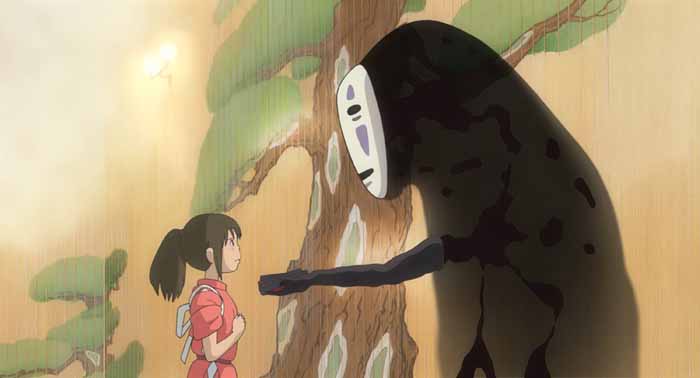
because he made me realize I had actually forgotten to believe in the goodness of humanity and in the possibility for purity in relationships between two people. I actually cried at the end of Castle in the Sky yesterday when (spoiler alert) the two kids recite a destruction spell, sacrificing themselves to save the magical floating city, Laputa, from descending into evil. My heart was tugged in places I haven't felt in a long time...it actually felt really good to cry. But frightening that those places felt so dusty and neglected--am I already old and bitter? Is there anything left of the bright, hope-filled child in me?

Saturday, May 15, 2010

Writing Dirty

A whole month! April has completely passed me by and I have not visited this blog once. I think it's because I'm still not completely sure why I'm doing it, and without a clear purpose, and without as much depressed free time I needed to distract myself from, the motivation's not quite there.

But going to Studio Fitz today for some informal piano performing and seeing Fitz's youtube channel full of all his amateur videos (and I mean amateur with none of the negative connotation--they are clever, experimental, and wonderfully uninhibited), made me excited to start something (anything) creative again. Like Fitz said, "If you're gonna do something, you gotta do it." I've definitely heard that sentiment before, about writing (and it goes without saying it applies to music as well). If you want to get good at your craft, you have to do it every day. You just have to. But if you're critical and inhibited, it can become a monumental feat to try to create. I think because I feel like I have a very clear sense of what I think's quality, I'm so afraid of not living up to it that I just freeze. Fitz's videos are great inspiration because he goes after every idea that pops into his head. Whether or not it turns into a gem, he won't know until it's done. So he just goes on faith. And a little bit on just not caring whether it'll be a work of genius or not. And I think that's just what you have to do with writing, too. A writer on a panel at a James River Writers event once made an analogy I like to think back to, about how almost every time she sits down to write, it's like she's diving into a dirty swimming pool. It's always covered with leaves, dirt, and algae but she has no choice but to stir it up a little before she can get to the beautiful clear water below (I believe her exact wording was something like "You've gotta wade through a lot of crap before you get to the good stuff"). You can't be afraid to get dirty.

At the very least, this blog serves the purpose of roughly documenting my time in Atlanta. I still remember a Joan Didion essay that really got to me where she talks about finding an old journal, full of a patchwork of recipes, poetry, and other flotsam and jetsam, and she values it so much because it reminds herself of who she once was. Not that you become a different person as you grow older, but the things that you spend your time thinking about, the things that really get to you from day to day, tend to shift and adapt to your changing lifestyle. So Didion writes to remember. Even if it is messy, and directionless, and sometimes just crap writing. I like that approach, so I'll be a great writer (according to Eliot) and steal it.

Friday, March 5, 2010

Disappontments of success

So, I got in to Bowling Green, after a terrible practice session-induced drunken walk home in the snow the night before. I was so afraid I wouldn't even be able to pull it together enough just to be accepted, much less get the assistantship I need so badly to be able to afford this. When I got that email, I was caught between ecstasy and the immediate diminishing I tend to do of a place that might actually want horrible me. Oh, and the fact that I still don't know whether they want me enough to give me money.  The other thing the acceptance caused was less of a desire to practice, or even the realization that I should be practicing. Two whole days went by without touching a keyboard and I hadn't even noticed anything was missing, I was so comfortable on the high of my successful audition. On the third day, I (no, wasn't raised from the dead--sorry, that just seemed like the logical thing to follow "on the third day") knew I should get my butt in gear, but enough other things came up that it got pushed aside.

Not only this but I don't even feel that happy anymore. Probably if I get the assistantship, I will have another mood spike. But when I went to see Mahler 3 last night I was overwhelmed with this sadness, sadness at the melancholy beautiful sounds coming out of some of those musicians' instruments, at the fact that I know I belong with them (in some "musician's realm?" what do I mean here? I'm not sure) but I'm not certain that that will ever be realized since I possess a little fat baby duck of a technique and can't fully express all the ideas I have on my instrument. Basically, even if I've come this far, it's not far enough, I'm too far behind, and I never will be able to catch up (is what was going through my head, along with all the other wonderful and awful sensations caused by Mahler and orchestral music).
 
I think this calls for a NY Times article (sent to me from a friend, to whom I'm grateful).

The article is "Depression's Upside" by Jonah Lehrer, and it follows two scholars in psychology who published a paper saying that proneness to depression is actually a beneficial, evolved trait. Studies have shown that the part of the brain that lights up with activity when we're highly focused on solving a task is extremely active in depressed patients. Lehrer says, "Human attention is a scarce resource — the neural effects of depression make sure the resource is efficiently allocated."

Except, when you're depressed, that kind of focus is called rumination, and it's not usually considered a good thing. Still, Paul Andrews, a VCU evolutionary psychologist, is convinced the brain has evolved this way for a reason. '“Of course, rumination is unpleasant,” Andrews says. “But it’s usually a response to something real, a real setback. It didn’t seem right that the brain would go haywire just when we need it most.”'

According to Lehrer, "If depression didn’t exist — if we didn’t react to stress and trauma with endless ruminations — then we would be less likely to solve our predicaments. Wisdom isn’t cheap, and we pay for it with pain."

The idea's simple enough. Thinking hard about real-life problems is painful, and is brought about by pain, but it's good for us in the long run. A friend told me that having a good day in the practice room can sometimes be the worst thing for you, because you're apt to get comfortable on those laurels. It's when you feel like you're at the bottom of the abyss, and the only thing you can do is think of ways to haul yourself out, that you're making the most progress.

I do think suffering is important. I wouldn't want it to be easy; then it wouldn't be nearly as engaging. I also think sadness is in some ways inherent to music, and delicious, so why not experience it as much and as often as possible, eh? Apparently, psychologists noticed this too. In the Times article, Lehrer talks about a social psychologist in Australia who decided to test the relationship between mood and focus/memory. To do this, he set up a bunch of tiny objects on the checkout counter in some shop and saw how many of the objects customers could remember when asked later. "To control for the effect of mood, Forgas conducted the survey on gray, rainy days — he accentuated the weather by playing Verdi’s “Requiem” — and on sunny days, using a soundtrack of Gilbert and Sullivan. The results were clear: shoppers in the “low mood” condition remembered nearly four times as many of the trinkets." Go Verdi.

Thursday, February 18, 2010

Slow down

All the other times I felt like I was getting better, I would be so fired up to play again, I'd gun it. I'd sightread as much as I wanted and turn off the telephone line between my brain and my body. It was too delicious to stumble through Chopin etudes and short Brahms pieces, maybe even play some of the Beethoven concerto I did a couple years ago. Come morning, I would never fail to plummet back where I was, or worse.

Now I've started doing a couple things differently. I spend more time warming up, legitimately paying attention to how my fingers feel. I use one hand to cradle the other as it plays, helping simulate the correct motion and basically playing the fingers forcefully the right way so I can stay relaxed and really learn how that feels (and note that it IS possible to play without tension). Also, I don't put so much pressure on myself. I'm not afraid of having a bad day, because I know it won't stay this way forever, and that it's going to be an extremely slow process. I know when it's best to just stop for the day even if things aren't going the way I'd like. There's no easy fix for this, and after a year I have HAD to accept that. But it's exciting to make small strides each day. I've still got a lot of work to do, but at the very least, I'm doing fewer things wrong.

And the cool thing is, when I force myself to go slower, I improve faster. When it hit the 2-weeks-before-my-audition mark, I got a little scared, but SO much good stuff has happened just since then (and it's been, what, only 5 days, and I've got almost 9 left). And you might think when I say "go slower" I'm speaking metaphorically, and being all tortoise/hare preachy. To some degree, yes, but also, I'm literally talking about tempo. The metronome, with its sometimes gentle, sometimes insistent, sometimes maddening little ticks, is my best friend.

Sunday, February 7, 2010

Small things

A few days ago I was able to play like I used to play, without any tension or pain, for the first time in a LONG time. I kept it up for a few days, and it was great--that constant dull throbbing that kept my attention on my arms all day whether I was driving or turning on a faucet or brushing my teeth was gone. I was almost able to forget that I have been suffering for an entire year (that's a long time). It was strange how effortlessly it happened in the practice room. I realized if I sort of held my arms differently and used my weight and gravity rather than my muscles, it felt great, and I just kept doing things that felt good and avoiding motions that didn't and that was that. It might be nice to think it was a miracle happening just in time for my audition on the 27th, but really I think it was a lot of tiny subtle corrections I made which made it possible to use my body efficiently. All year my teachers couldn't see anything but tiny subtle things wrong with my playing. It took a Taubman lesson to notice a number of small but hugely significant things I was doing--clenching my fingers, curling my fingers beyond their natural curve, breaking the natural straight line that runs from the elbow through the wrist to the fingers by twisting, and letting my wrist collapse, to name a few. I couldn't correct them all right away. Muscle memory is a powerful thing. But I think some conscious and subconscious work (just realizing what the problems are, for starters) has gone a long way and I have HOPE again. It's weird to say that I lost it, because I don't think it ever got that bad, but for sure I couldn't see the light at the end of the tunnel and now I can, and now that I'm permitting myself to freely imagine how great it could be to be in grad school next year studying piano all the time, I'm much happier about my current situation, i.e., its non-permanence.

All right, enough stream of consciousness and mile-long sentences. But I'm interested in the notion of lots of tiny things contributing to a much larger effect. How a person can become consumed by blinding rage over getting cut off at a stop light after a day that consisted of stepping in a puddle of roommate's dog's piss and being yelled at by a belligerent boss. Or a kid who gets 15 minutes more sleep every day for a week and does better on a test, or a person who drinks tea every day and doesn't get sick as often. I know I've wanted to cry and say the world is a cruel cruel place over a flat tire, what seems like one tiny thing but really is just the last straw that reveals a swarming mass of other tiny things that have been bothering me and been left unconfronted, adding up to a meltdown of sorts. But if I just keep my eyes and ears peeled for the small things as they come, I can work on accumulating more of the tea-drinking kind and less of the meltdown/tendonitis kind.

Remember La Bouche? Finding this was a real throwback (and trippy).

Friday, January 29, 2010

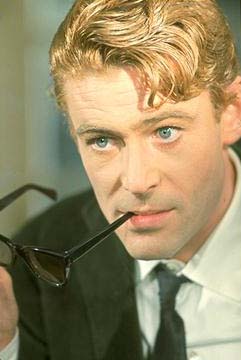
This is why I love Peter O'Toole


He was born in Ireland, he played T.E. Lawrence (who is epic, and had a romantic young motorcycle death) and he's downright beautiful and of course charmingly British. IMDB lists as one of his trademarks "His blue eyes" and says under trivia that nuns in the Catholic school he attended beat his left-handedness out of him. Also in his IMDB profile is a quote from Noel Coward to O'Toole:  "If you'd been any prettier, it would have been Florence of Arabia."

The great thing about being an actor, or really any performer who gets filmed a lot, is that they can preserve themselves at their most youthful and attractive for generations and generations. Sure they can't escape aging like the rest of us mortals, but it's probably the closest thing to it. It's kind of like the way memory freezes people if you stop seeing them, or if you only knew them for a short time. Then if you happen to meet up with them years later, unless they haven't aged/developed at all, they occupy a totally new entry in your brain, as if they're a new person. This is kind of a weird example, but I remember when I helped direct a high school musical and I worked with the same kids intensively for two months straight, I realized I would probably never see these kids again, and they would be 16, 17 and 18 in my head FOREVER. And I would be a 22-year-old college senior in their heads forever.

I remember being shocked and a little depressed when, after I went on a Robert Plant kick and checked out a bunch of Led Zeppelin concert DVDs from the library and drooled over his shirtless/long haired/androgynous/microphone thrusting sex appeal, I google imaged Plant and found what looked like a shriveled troll who looked like he belonged under a bridge somewhere. And it's not much better for O'Toole. Or Ginger Rogers for that matter. I will allow Fred Astaire to be one example of someone who pretty much kept the same appeal until death, but that's because he was ALWAYS ugly-hot. Anyway, once I got past the disturbing fact that people, including my beloved film icons, don't always age well, I reveled in the beauty of film, photographs, memory, and frozen time. It's kind of how I feel about people in my past, who, for whatever reason our friendship or relationship or whatever didn't work out. Good memories are always there to be replayed, and that's kind of comforting.

Tuesday, January 26, 2010

Meeoww


"He signed with cat’s silhouette. And the (dismantleable) cenotaph that was solemnly honored, following his death, in the Louvre’s Cour carr¾ , was topped by a late Egyptian bronze: the cat-goddess, Bastet, her nose raised toward the cosmos. Cats sign by scratching. Not long ago, people called them clerks and griffins. They also sign the indeterminacy of space and time by their whimsical comings and goings – some cheery, some nasty – stopping at thresholds we cannot see where they sniff some ‘present beyond’. The beyond of a just-this-side – the one that roars or rumbles or purrs in their throats. ....Of the ellipsis, they understand much. And the name for this, the name for this life at the threshold, for the door that’s ajar, for questioning: is limbo."

Saturday, January 23, 2010

Mah-tay

It's amazing how different I can feel from day to day (and the difference is especially pronounced when I don't have my tea). I think a quote from Borges is appropriate.

"Years of solitude had taught him that although in one's memory days all tend to be the same, there wasn't a day, even when a man was in jail or hospital, that didn't have its surprises."

And then

"The taste of the mate, the taste of the black tobacco, the growing band of shade that slowly crept across the patio--these were reason enough to live."

From The Wait.


On a side note
After my interview with KitchenAid, I REALLY want to work there. They made the job sound great. I can see a FUTURE with them. I just want to wear that red apron and go around operating stand mixers all day!

Thursday, January 21, 2010

It's job time. Everyone get your jobs!


I have an interview with KitchenAid tomorrow. I'm also applying at the library. I can see myself becoming a librarian if music doesn't work out. I don't know if I can see myself becoming a housewife.

Saturday, January 16, 2010

...

I think there's a small rodent caught in my wall. I heard clawing and thuds periodically throughout the afternoon, and then I heard some breathless moans, if that's the right word, because I can't think of the word to describe the guttural emanations I heard, starting loud and gradually dying out as if the thing were losing a fight.

The apartment either below me or directly across the hall from me always wafts smells and sounds of good food and merriment in my direction. Today, coming in after a fruitless attempt to get a retail job and print out piano lesson fliers at the zombie-infested library, I detected barbecue chicken.

Tuesday, January 12, 2010

Kay Nielsen has tapped into my subconscious


I came across this picture randomly, with no explanation of where it was from or who did it but I knew immediately. It was from East of the Sun and West of the Moon. A book my great great aunt gave me when I was 5 when my family visited her in St. Louis. I have such fond memories of that book, and of the glossy color illustrations. So when I came across the picture I decided to get out the book (which I've always kept--now it's 82 years old) and look at it again and remind myself which story this picture came from. But it was not to be found. My book has art from an entirely different illustrator (Hedwig Collin, not the famous Kay Nielsen who did the one I pasted above). I'm completely at a loss as to why this picture exists in my memory.

For more Kay Nielsen: http://www.animationarchive.org/2005/12/media-kay-nielsen-twelve-dancing.html