Sunday, October 25, 2009
H-A-double L-O, W-double E-N spells...
Ooooooooooooo
I wanted to link to a video of this favorite elementary school Halloween song of mine, or the one in the title of this post, but good versions don't exist on Youtube.
There is this, though. Oh, Sanderson sisters. Halloween is my favorite holiday.
Monday, October 19, 2009
A Legitimately Good Day
Saturday, October 17, 2009
That's Weird...
Compliments From Strangers, Vol. 2
Tuesday, October 13, 2009
Packin' Some Protein
Afterthought: If you decide to try the recipe I made tonight, don't be afraid of the dilemma of cooking the chicken all the way through without burning the pecans/walnuts (I was very scared). Just make sure the chicken is pounded out thin enough before you start, and also don't worry if the nuts get dark brown--just stay away from black. Then you've got a charred lump of coal that nobody's going to want to eat.
Monday, October 12, 2009
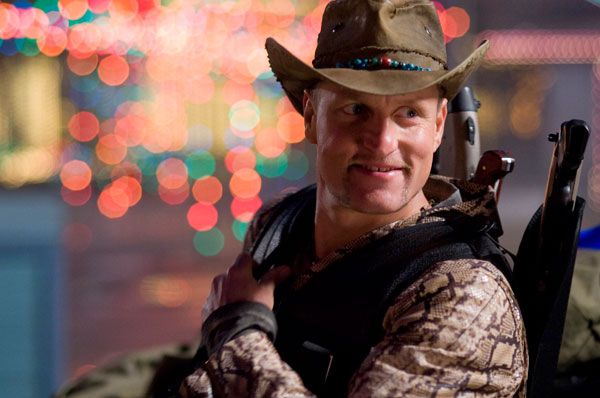
Zombieland
With zombies, obviously.
My favorite part is that this is a zombie movie that isn't about zombies. The zombies are a vehicle--they give the four characters a reason to:
1. Forget every restriction of society (like the unwritten rule that it's not OK to go around looting and smashing random cars' windows, for example)
2. Go on a cool journey cross-country (luckily with an unlimited supply of gas)
3. Learn to get along with each other (it's not like there's a single other human being on the planet)
4. Meet celebrities (and get away with murder)
5. Lose inhibitions and hook up, but not distastefully. (see #3)
Each character starts out determined not to trust anyone. Because of this, nobody has names, and they are referred to only by their destinations. Columbus, played by Jesse Eisenberg, just wants to see if his family has survived the zombie virus. His debilitating insecurities make him lovable, and the unlikely pairing with Tallahassee (Woody Harrelson), makes for some excellently awkward conversation.
The two sisters' (played by Abigail Breslin and Emma Stone of Superbad) unwavering determination to get to Pacific Playland is cute. They have nothing left to work towards or live for, so they come up with a goal--they will survive and they WILL have fun, despite the fact that the world as they know it is destroyed. In keeping with the trust noone policy, they con Columbus and Tallahassee twice. Of course, after all is said and done, they all end up one big happy family. Fighting zombies is the ultimate trust exercise. And who wouldn't choose being friends over the alternative (see #3)?
Something I really like about this movie is the sense of place. I don't feel like enough movies and books really put setting to good use. Not only does the movie explore every aspect of the various destinations the characters end up at, but the destinations are well-chosen in the first place--lots of vivid colors, full of things good for smashing, just all-around imagination candy. I mean, why stick to hunting zombies in downtown Atlanta (that's where part of the opening sequence was filmed!) when you can hunt them in quirky gift shops in New Mexico, or gas station bathrooms, or Bill Murray's house, or an amusement park? Just think of all the great possibilities for zombies in amusement parks. I won't ruin it for you, but just think.
Woody Harrelson was also great in this, and provided the film with lots of nicely packaged take-away phrases, like "Nut up or shut up," and "That'll do, pig." They may have tried a little too hard to get "Nut up or shut up" to stick, seeing as Harrelson's character uses it twice in the movie AND I see the phrase is in a big banner stretching across the photo on imdb.com. Still, his character is not cliche at all. He's obsessed with Twinkies and his ardent quest for just a taste of the golden snack cake develops his character nicely. (When they visit Bill Murray's mansion, the Twinkie clip from Ghostbusters is conveniently shown in Murray's personal home theater--a little contrived, but I still appreciate the effort to connect everything.)
Definitely too much unnecessary gore, especially in the opening sequence, because this movie isn't really about zombies at all. It's a comedy! And like a lot of comedies, there are some moments that are just absolutely over the top. Still, I think, overall, the movie strikes a good balance of an organically unfolding plot and outrageously absurd events so that the audience is willing to accept and laugh at the ridiculous things and still get something a little deeper out of it.
Thursday, October 8, 2009
My Dream Man
I think they realize their tactics have'nt been working on me. I'm a tough one. So they changed up the strategy. Today, it said "Meet Single Dads." Finally! Just what I've been waiting for.
Monday, October 5, 2009
Jealous of Strippers
Current Soundtrack: Be On You by Flo Rida.
Ever since we went to "Babes" on Bourbon Street that song has kind of been stuck in my head. I feel like it's probably because it is a great song to strip to. It has a great beat, but it's not fast, so you can be all slow and smooth, like Dr. Dre on the Dr. Pepper commercial. At least one girl, but I'm pretty sure multiple girls, stripped to it over the span of time we were in the club. (As an aside, we found out later that the girls can't pick their songs, only the genre of music they want to dance to. I wonder what would happen if they picked oom-pah or death metal.) And of course whenever I listen to "Be On You" I'm overcome by the power of songs to stir up memories. In this case, memories of half naked girls getting fully naked to music (well almost fully naked--there's a law in Louisiana that there must be underwear).
But let me just say why Ali and I decided we needed to witness this. We were curious! And we're girls, so it's not sketchy. Plus, there's our perspective. We're technically at the prime stripping age. Over 21, but not too far over. Just graduated college, no job yet, and we got bills to pay, son. Champagne (real name Jennifer) said she can make $15,000 a month.
And they kind of look like they're having fun up there. Champagne said not so much. She actually said she hates her job. I guess that's to be expected, but to me it looks totally courageous and fun. Those girls have got to be fearless to bare it all. They certainly don't all have perfect bodies, but the men we saw had more than enough love and money to go around and they didn't seem to discriminate. And, of course, if some clients have too much uncontrollable love, the strippers are well protected by the establishment.
Ali and I, on the other hand, judged them based on ability. Champagne, for instance, could climb the pole practically to the ceiling and then slide down upside-down, spread-eagled, in 5-inch platform heels that she confirmed are heavy. Even if some of these girls don't have the perfect rack or are packing a few extra pounds in the gut, something must be said for their flexibility and upper body strength.
If I had an excuse to stay fit, learn how to really handle a pair of heels, and build confidence enough to be naked in front of strangers, all while being paid $15,000 a month, I think that might be the opposite of exploitation--I think that might be pretty empowering. Not a lifetime career choice, obviously, but still cool.
Sunday, October 4, 2009
Addicted to Feeling Sad?
"Dear Prudie,
My mother's grief makes me uncomfortable. She lost her mother more than a year ago and still cries copiously and frequently (in public and in private) when she thinks about it. She brings the death up in unrelated conversations with strangers (including cashiers!), acquaintances, and friends."
Prudie replied that she thought the mother might be suffering from a newly recognized "distinct syndrome" and referenced a Washington Post article. In the article, Rob Stein describes what psychology and psychiatry professors are finding: that there is a specific system in the brain that is used in certain people who suffer from seemingly unending grief. Thus, it may be a physiological syndrome rather than a stubborn unwillingness to let go of the person who died. They're calling it complex grief (does that make people who can move on simple grievers?).
In the article, professors talk about why the use of this particular part of the brain is significant:
Mary-Frances O'Connor from the University of California at Los Angeles says: "'This is the part of the brain involved in knowing that you want something. When people who are not adjusting well are having these sorts of thoughts about the person, they are experiencing this reward pathway being activated. They really are craving in a way that perhaps is not allowing them or helping them adapt to the new reality.'"
"The same brain system is involved in other powerful cravings, such those that afflict drug addicts and alcoholics," says Stein.
Bingo. So the complex grievers are addicted to something. To happy memories, according to the article. But the grievers weren't addicted to their loved ones before they died--only after they were taken away. Is it possible that these people are somehow predisposed physiologically to wanting what they can't have? Does the process of craving without the reward of satisfaction feel good to them, good enough to become trapped in a neverending cycle of sadness?
There are a lot of online forums, like yahoo or ehealth, for people who feel this way.
"Sadness is the only thing that makes me feel alive," says a frequenter of one forum. "Sadness is the best drug I can get my hands on."
"There's something alluring about it, seductive," says another. "Maybe its the self pitying that is so attractive--it mocks self love."
Someone else writes on a yahoo forum that he is addicted to depression because of the art he produces while under its spell: "I've tried to write when I'm happy--honestly, I can't write when I'm happy," he says (Virginia Woolf was bipolar and wrote during almost hysteric bursts of productivity).
Rob Stein posits that the recent physiological findings on complex grief may explain why depression medication has not worked for these grievers--a different brain system (one involving serotonin) is in use for depression patients. But he didn't consider that there could be such a thing as complex depression. In which case, depression medication wouldn't work for depression addicts or complex grievers. Because in a strange way, they don't want to get better.